|
Home
Biographies
Locations
Balsham
Bassingbourn
Cambridge
Cottenham
Fen Ditton
Gt and Lt Shelford
Haddenham
Littleport
Peterborough
St Ives
Soham
Wisbech
Links and thanks
|
The Journal of the New Cambridge Police 1837-8
| Introduction | Policing Cambridge in the1830s | The Cambridge Station House | Transcripts | Analysis | Journal Content | Borough Police Regs | Watch Committee Report 1836 | Cast List |
Cambridge Station House
The Watch Committee quickly set about providing a station house for their new force. Earlier police arrangements did not include such a provision and so the new Committee had no building to take over and had to address this task afresh. Approaches were made to use a room or rooms at the Town Hall or at the Workhouse in St Andrews Street (run by Hobson’s Charity and also known as the House of Correction or Spinning House). Speaking years later, in 1901, the then Chief Constable, C.E.Holland, reported that both approaches had failed and that the force experienced real difficulties in the quest for a station house. (Cambridge Independent Press 11 October 1901 p6 and Cambridge Daily News 7 October 1901 p.3).
Perhaps with some relief the Watch Committee hit upon a third alternative. Alderman Charles Humfrey, then a member of the Watch Committee, offered the Committee part of a mews building in Miller’s Lane (now re-named Emmanuel Road) which he had built in the grounds of his mansion. The following two advertisements explain that the building was part of a speculative development built by Humfrey between 1826 and 1828, at least part of which was standing empty in 1836.
(Cambridge Chronicle 4 August 1826 p3) Stables and Gardens. Any inhabitant of Cambridge who (from living in the close part of the town)
may be without a chaise house and stable, and desirous to hire or buy such places, with or without a garden attached to them, may be accommodated by applying to Mr Humfrey, who intends to erect upon a uniform plan (though of different sizes) a range of buildings for that purpose on the north side of his kitchen garden and opposite Christ’s College Pieces, if he can find customers for them. Particulars will be communicated to those who may do him the favour to call upon him any morning between eleven and twelve o’clock
(Cambridge Chronicle 17 Oct 1828 p3) To the public, particularly to members of the university. Stables and coach-houses have been recently erected near Christ’s College Pieces, upon a considerable scale and it is presumed possessing advantages, from their extent and arrangement, which such buildings generally do not. The stalls are more than two yards wide, five yards long and three yards and a half in height. There are also some Loose Boxes the same height and length, but considerably wider; and others which are rather less. The coach houses are of different lines. There is an open space for exercise 300ft by 30 feet; a covered ride 240 by 12 feet, which is very lofty; with some pumps and plenty of the best water. A single stall, or any number, may be had and with each a separate hay loft, straw loft and dung hill. – There are two cottages on the premises which are to be inhabited by grooms, who understand their business; but it is by no means necessary that they should be engaged; they will however be on the spot and glad to be employed by those gentlemen who, having no servants of their own, may require their assistance. Further particulars may be known by an application made to persons on the spot.
The deal struck between Humfrey and the Watch Committee was that the unoccupied central part of the mews would be rented to the Borough as a police station house for £50 per annum and the Watch Committee would pay for the necessary works to adapt their part of the building for its new purpose. Humfrey was adamant that he should incur no costs as a result of the lease. Conversion of the premises, included work by a plumber, carpenter, bricklayer, plasterer and gas fitter, in total costing £235.2.3d.
An editorial in the Cambridge Chronicle 6 January 1837 p2 criticised a deal between the Watch Committee and one of its members. Then Cambridge Chronicle 5 May 1838 p2, included a letter claiming that the overall cost to the Watch Committee had been far too high and that the transaction between the Committee and one of its members was not lawful. The contrary argument was made by the Mayor in the Town Council, claiming that he was quite satisfied that a station house would have cost double the sum in any other place. (Cambridge Chronicle Friday 11 November 1836, Page 2). Humfrey claimed that, as the central part of the mews included the gateway, the Watch Committee was liable for the costs of installing two new gateways giving access to his remaining parts of the mews, a claim which was fiercely resisted. As a result of the dispute, Humfrey resigned from the Committee (Cambridge Chronicle Friday 19 August 1836).
The Station House building was of brick and slate. The frontage on Millers Lane was 50 ft 2 in, and the depth of the plot was 71 ft. The Station House had an office for conducting business, at least two cells for prisoners, a men’s room with a fire, (not close enough to warm the cells) and a residence for an inspector or sergeant. There was also a gated yard, with gas lights above a gate. Instructions from the Superintendent demanded that the gate must be kept locked at all times so there must also have been some sort of pedestrian access. The Watch Committee occupied this building as the Station House until 1852 when they took over part of the former house of correction in St Andrew’s Street as had been explored, but refused, back in 1836. After Charles Humfrey’s death the Station House and a number of his other properties were auctioned on 21 August 1849. (Cambridgeshire Collection, Sale catalogue 21 August 1849).
As far as the writer is aware no photograph of the Millers Lane Station House has survived. The Royal Commission on Historic Monuments – City of Cambridge 1959 Vol 2 page 361, Monument 263 describes what now remains of the mews:
“Christ’s Piece, East side, Houses a pair, Nos 5 and 13 Emmanuel Road standing some 78 yards apart symmetrically between Parker Street and Orchard Street, facing Christ’s Piece are of two storeys and have walls of gault brick with stone dressings and slate covered roofs. They were built as grooms’ houses between 1826 and 1828 and architecturally devised as the small pavilion like terminal features to a long range on the NW boundary of the grounds of Charles Humfrey’s house, Clarendon House, which stood between Clarendon Street, Victoria Street and Earl Street. The range was built by Humfrey for letting as mews but the middle part was leased to the Borough and adapted for use as a police station. It is shown on R.G.Baker’s map of 1830. (Plans for lease of police Station CUL Maps 53 (2) 84.13. Cambridge Chronicle 6 Jan 1837, 5 May 1838, 18 July 1846.)
Elm Street and Victoria Street both cut through the central part of the former mews, but one short section of the original station house building remains, as 1A Victoria Street as can be seen in the photograph below..
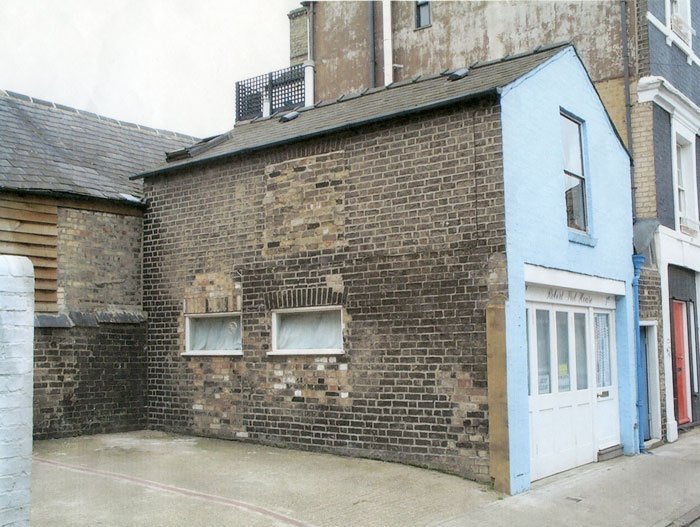
A small part of the old Station House, still visible in Victoria Street, Cambridge
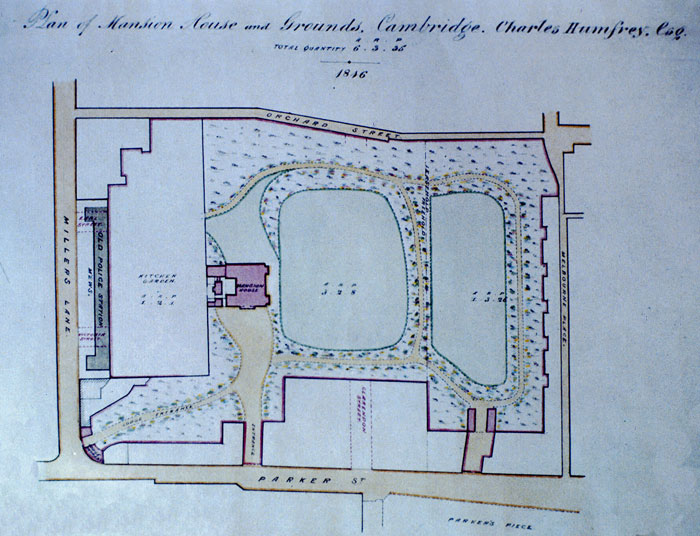
Chas Humfrey's mansion (in red) with the Mews, Millers Lane in grey
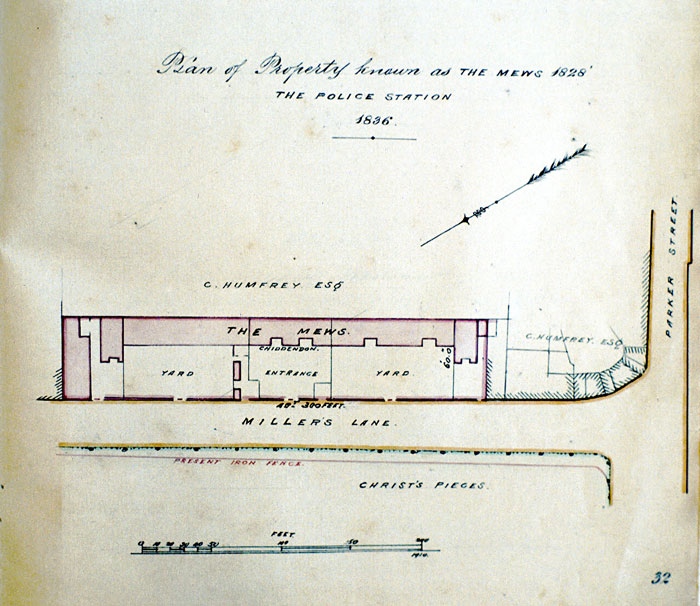
The Mews in Miller's Lane, the Station House in the central part
The Cambridge Chronicle, 6 May 1836 Page 2, carried an announcement in the name of John Titterton, Superintendent:
Cambridge New Police. The public are informed that the Police Station House is situate in Millers Lane where they are requested to send information of robberies, riots, assaults or alarms of fire when the assistance of the Police will be immediately given.
|