Cambridgeshire
Police
History
Notes
CambridgeshirePoliceHistoryNotes |
|
|
|
Locations Balsham
|
Policing St Ives, Huntingdonshire, 1820-1858 | Introduction | The High Constables of Huntingdonshire | St Ives Parish Constables | The Rural Constabulary Act 1839 | The St Ives Lock-Up | Improving the town | Parish Constables Act 1842 | Parish Constables Act 1850 | Other Law Enforcers in St Ives | Co-operation between officers | The new Huntingdonshire Constabulary | References and Notes | Appendix A. The St Ives Police Officers | Appendix B, St Ives Householders Nominated to Serve as Parish Constables, by year, 1842-1858 | Appendix C, Alphabetical Listing of Householders Nominated and Serving as Constables 1842 – 1858 | Appendix D, County of Huntingdon. Rules and Regulations for the Guidance of the Superintending Constables | St Ives is a small town in Cambridgeshire. In the early 19th Century it was a parish in the Hurstingstone Hundred of the former County of Huntingdonshire. The town was best known for its nationally important livestock market. The population of St Ives was: 1801: 2,099, 1811: 2,426, 1821: 2,777, 1831: 3,314, 1841: 3,514, 1851: 3,572, 1861: 3,395. In most of rural England in the early years of the 19th century, basic policing functions were carried out by Parish Constables. These were householders nominated annually by the local Vestry. Parish Constables were generally unpaid, but could claim expenses or disbursements for performing specific tasks, such as serving a summons, executing a warrant or taking a prisoner from court to gaol. This was a relatively inexpensive system which drew on the local knowledge of those appointed constables. On the negative side, from an individual perspective, appointment could be onerous and time consuming, interfering with family and business life and was even, at times, dangerous. Former Constables continued to live in the communities they had policed, which could, on occasions, make them reluctant to act. Annual appointment meant that at any one time most Parish Constables were relatively inexperienced. It was possible to avoid serving as a Parish Constable, for example by paying a fine or paying another person to act as a substitute. Where the same individual acted repeatedly as a substitute, this might allow the developing of better skills and greater understanding of the role. Conversely the appointment of the cheapest substitutes could mean that little regard was paid to the qualities these stand-ins brought to the role. This review of early 19th Century policing in St Ives shows how one particular community avoided some of the weaknesses of the Parish Constable system. However, many 19th Century records have not survived and so much more detail remains to be discovered. For example, what motivated some individuals to serve as Parish Constables for a number of years ? Exactly how did the St Ives Vestry choose the householders they nominated to serve as Parish Constables and how did the Magistrates select and appoint Constables from those nominated ? This paper also considers the effects in St Ives of a number of measures introduced by the government to improve policing in England between 1830 and 1858. In 1829, in the face of rising crime in the Capital, the Government established The Metropolitan Police: a visible uniformed, mainly preventative, policing body. Over the next few years the new force successfully took over policing functions from Parish Constables and watchmen across London (with the exception of the City of London). A few years later the government of larger Boroughs in England and Wales was reformed under the Municipal Corporations Act 1836. This Act required incorporated boroughs to establish police forces to operate by day and night under the direction of Watch Committees. In Huntingdonshire the 1836 Act applied to the Incorporated Boroughs of Huntingdon and Godmanchester. Both established small police forces overseen by Watch Committees but as St Ives was not an incorporated Borough, it was not directory affected by this provision. Further attempts by the Government to extend the new police arrangements more generally resulted in the passage of the Rural Constabulary Act in 1839. This Act allowed magistrates to establish rural police forces in the whole, or, after 1840, part of their Counties. The Act was permissive and was never adopted by Huntingdonshire Justices. There were further law enforcement options available should local Magistrates anticipate a situation beyond the control of the normal parish officers. Magistrates could swear in Special Constables to assist the Parish Constables. For example, in the Hurstingstone Hundred in 1830, in the face of rising disorder and anti-police hostility in Ramsey, fifty Special Constables were sworn in by St Ives Magistrates to help the single Parish Constable there (Cambridge Independent Press, 6 January 1849 p4). In St Ives, extra specials were used to help police the twice yearly fairs. In the rare and extreme event that serious disorder was feared, beyond the capability of Parish and Special Constables, Magistrates could seek the authorisation of the Secretary of State for military support. No examples of this more extreme measure have been found for St Ives. Huntingdonshire Justices finally formed a County Constabulary in 1857 when this was mandated by further government reforms embodied in the 1856 County and Borough Police Act. The High Constables of Huntingdonshire Pigott's Directory of St Ives, 1823, includes a statement that the "Police of the Town is under the superintendence of a High Constable". In Huntingdonshire at this time there were two High Constables appointed in each of the four Hundreds. The High Constables were salaried. In the Hurstingstone Hundred, High Constables John Danns and John Julian served for a number of years and were each paid a salary of £20 per annum. John Danns had been in post for 50 years when he voluntarily resigned in 1853 on the grounds of his extreme age. The High Constable posts had a higher status than the Parish Constable and High Constables were exempt from serving in some other parish posts, including that of a Parish Constable. The most important roles of the High Constables by the early 19th Century were to collect the rates, to attend the Quarter Sessions, and pay all monies collected to the Treasurer. There were also a number of minor statutory administrative duties they performed, which included issuing precepts to the Overseers to prepare jury lists, issuing notices received from the Justices of various court sessions and meetings, preparing lists under the Militia Act of 1825, and publicising meetings under the Alehouse Act 1828. ( 6 Geo 4th c.50 s 6 and 10 and 9 Geo 4th c 61, s2 and s5,) The two Hurstingstone High Constables, John Julian and John Danns lived at Bury and Little Stukeley respectively and so might not have taken a particularly strong interest in the day to day functioning of the St Ives Constables. However, in all of their administrative duties the High Constables probably delegated parish level tasks to the Parish Constables and could thus be said to have their superintendence. No other examples have been found suggesting that the High Constables performed any supervisory policing functions in St Ives. St Ives managed to improve on the old Parish Constable system in a number of different ways.
The mechanism by which constables served for extended periods remains largely unknown. Perhaps some were willing volunteers. It may have been possible, in this urban setting, for a few Constables to have performed some policing functions on a part-time basis in order to supplement their income with the small sums they claimed for undertaking specific duties. An examination of Constables’ Disbursements would show if this was the case, but it is not believed that any records of Constables’ disbursements or their repayment have survived. Nor does it seem possible to isolate payments to constables from such vestry or county or court accounts as have survived. The only example found of payment to a specific Constable comes from the Quarter Sessions minutes for 14 Oct 1839 which include a payment to Thomas Cole for “attending St Ives Bench and sessions - £2.14.6.” Then on 30 December 1839: £2.12.6. and 6 April 1840: £2.14.6. It is not clear whether these payments were by way of a salary or payments for specific expenses and tasks. The extent to which Vestries paid Constables a salary is not clear. There is evidence in Vestry Minutes of some such payment between 1839 and 1844, discussed below. The Rural Constabulary Act 1839 The 1839 Act enabled Justices to establish and maintain professional County Constabularies but was permissive rather than mandatory. Huntingdonshire Justices planned a discussion on adopting the Act at an adjourned session on 18 January 1840, but in the event, no discussion took place as the proposed meeting was cancelled. There are no surviving records suggesting that the County Justices ever formally debated and voted on the adoption of the Act. (Cambridge Chronicle, 11 Jan 1840 p1 and 25 January 1840). Instead of establishing a new police, the County Justices focussed on getting the best from the system of Parish Constables. James Rust Esq, Chairman of the Huntingdonshire Sessions, spoke to fellow Justices on the subject of Parish Constable appointments across the whole County saying:
In October 1842 the Chairman of the Huntingdonshire Quarter Sessions reflected on the non adoption by the County of the 1839 Act. Instead he extolled the virtues of the 1842 Parish Constables Act.
He dilated at considerable length on the Act and stated that, in those parishes which thought proper to appoint paid constables, there was no necessity for their appointment by the magistrates, and strongly enforced the necessity of proper persons being selected to fill that office. (Cambridge Independent Press, 22 October 1842 p4) Neighbouring Cambridgeshire Magistrates also rejected the 1839 Act after discussion in October 1844 (Cambridge Independent Press, 5 October 1844 p2), but went on to adopt the Act in 1851. Other forces adjoining Huntingdonshire established constabularies under the 1839 Act: Bedfordshire in 1839, Northamptonshire in 1840 and The Isle of Ely in 1841. Lord Campbell, addressing the Grand Jury at the Huntingdon Assizes in 1852, lamented the fact that there was no new Rural Constabulary in the County and he expressed the view that Huntingdonshire might become a magnet for burglars from surrounding, better protected, counties adding
When a Constable made an arrest it was not always possible to take the offender immediately to a Magistrate. If a Magistrate was unavailable or it was necessary to keep the offender locally, perhaps while enquiries were being made, some sort of secure accommodation was required. In some parishes this would have been a single cell, known as a cage or lock-up. In other places the Justices may have made do with paying for the occasional use of a room or outbuilding perhaps at a local inn. By early in the 19th century St Ives had a cage. Hunts Archives has depositions HCP/1/10/47 from 1825 recording assistance given to the watchmen and constables in putting two prisoners into the cage after a street fight. The St Ives Vestry minutes (HP72/8/1/2) mention new buildings in 1817/18 in the yard of the old workhouse, in what is now Station Road, and the erection of a new cage there in 1825. A cell was included at the St Ives Union workhouse, built 1837/8, but this was on London Road, Hemingford Grey, some distance from the centre of the town, and in any case may have been solely for the use of the Guardians. The St Ives Vestry proposed in 1841 (KHP72/8/1/2) the disposal of the old workhouse and use of the funds raised to build a new station house with two cells, and engine house for the town’s fire appliances, on a piece of waste land, already owned by the town, in Nicholl’s Lane. Events were however overtaken by a new provision in Sections 22/23 of the Parish Constables Act of 1842, enacted on 12 August 1842. This permitted Justices to build lock-ups for the temporary confinement of prisoners. The cost was to come from the County Rates and plans had to be approved by the Secretary of State. Section 23 of the Act required the Justices who took advantage of S.22 to appoint a Superintending Constable to have charge of the lock up, to have all the powers of a Parish Constable and have charge of the Parish Constables in any other parishes agreed by the magistrates. The Superintending Constable (title more usually shortened to “Superintendent” or occasionally to “PS”) was to hold office until removed by the Justices and was to be paid a salary from the rates. At the Huntingdonshire Quarter Session, on 26th November 1842, seven JPs proposed the building of a St Ives lock-up. A search was started for a suitable plot of land, an architect was appointed and plans for a lock-up/station house were submitted to Sir James Graham, the Secretary of State. In February 1844 the Huntingdonshire Justices formed a committee to oversee the erection of the St Ives lock-up house. (Cambridge Chronicle 12 November 1842 p1, Cambridge Independent Press, 10 February 1844 p3). A plot of land was found in Priory Road St Ives. Advertisements were placed for tenders "to construct St Ives lock up house to drawings by J D Hopkins 25 Bedford Sq, architect, and approved by the Secretary of state”. (Cambridge Chronicle 8 June 1844 p4). Construction of the building, with cells plus accommodation for the Superintending Constable, was quickly undertaken. By July 1844 the press reported:
Payment from the Justices was completed in May 1845. (Cambridge Independent Press, 19 October 1844 p4 and Cambridge Independent Press, Saturday 31 May 1845 p3).
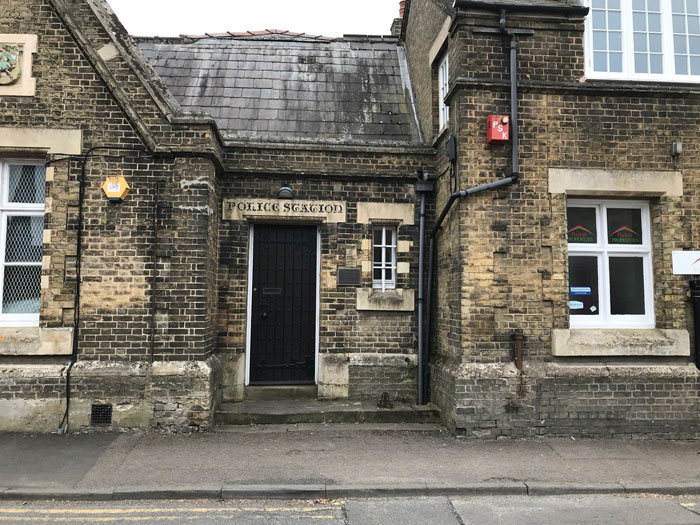
St Ives lock-up photographed in 2025 Quarter Session in 1844 agreed that a Superintending Constable should be appointed for the St Ives Lock up. St Ives magistrates were charged with finding and proposing an experienced and efficient London officer, a married man without encumbrances, and with drawing up a list of the parishes whose Parish Constables he would be superintending. The first Superintending Constable appointed in April 1845 to oversee the lock up was Charles Wootton, at a salary of twenty five shillings per week, plus coals to heat the building. The St Ives bench was tasked by Quarter Sessions with submitting to them the Rules and Regulations which would apply to the post and the scheme listing the Parishes where the Superintending Constable would oversee the work of the Parish Constables. The St Ives bench asked for more time to prepare these, but no trace has been found in the Quarter Sessions records or the local press of any such Rules and Regulations or list of parishes to be overseen. Perhaps the St Ives bench simply failed to produce these documents as instructed. One possible reason for the St Ives bench deferring this was a piece of work by Quarter Sessions to re-align the boundaries of the four ancient Hundreds, making them more manageable as Petty Sessional Divisions. For Hurstingstone, this meant losing to Leightonstone the Parishes of Hartford, Great Stukeley, and Little Stukeley. (Cambridge Chronicle 27 June 1846 p1). Charles Wootton served as St Ives Superintending Constable until October 1849 and was replaced by Sgt William Benson, who served until the post was abolished on the formation of the Huntingdonshire Constabulary in 1857. The 1845 lock up and house was improved in 1853 by Geo Bunting, builder, of Fenstanton and was taken over by the new Huntingdonshire Constabulary in 1857. The building was further extended with the addition of a Magistrates’ Court (1884) and a female cell (1919). The building can still be seen in Priory Road where a blue plaque refers to it as the "Old Police Station". (Cambridge Independent Press, 19 November 1853 p7, Cambridge Chronicle, Saturday 10 December 1853 p8) The process of obtaining the local act did not go well. Some householders, no doubt, felt that the potential costs to them outweighed any likely benefits. A public meeting was held at the Crown Inn on Friday 31 January 1840 when speeches in favour and against seeking an improvement act were given. Opponents of the idea achieved a majority in the vote at the end of the meeting. (Cambridge General Advertiser 5 February 1840 p3) The following year another public meeting was held at the Crown Inn, St Ives, to consider applying to parliament for a local Act for lighting, watching and cleansing the town. The meeting was not the success for which the organisers hoped. A further attempt to start the process of obtaining an improvement act was made in November 1845 with a similar press announcement to that made in 1839. (Cambridge Independent Press, 1 November 1845 p1). Almost a year later the Cambridge Chronicle (24 October 1846 p3) reported that a meeting of several influential and respectable inhabitants of St Ives, John Birt Ulph esq, ironmonger, in the chair, had taken place at the Unicorn and had agreed to apply to Parliament for a local improvement act. A Committee was formed to take this forward. Another announcement of intent to apply for a local act appeared in the Cambridge Chronicle, 28 November 1846 p6. No record has been found to suggest how, or by whom, this process was to be funded. A bill was duly introduced in Parliament. Mr Rickards, Barrister and Mr Higgins, architect, surveying officers under the proposed act attended at the Unicorn Inn on Tues 9th February 1847 for the purpose of examining and surveying the district and making enquiries relative to the provisions of the Act. (Cambridge Chronicle, 30 January 1847 p1). The St. Ives (Huntingdonshire) Improvement Act 1847 was finally passed on 22 July 1847, some sixteen years after something similar had first been proposed. PC Philemon Douglas HEMP was the first Constable appointed “during the pleasure of the Commissioners” and at a salary of one guinea per week. Unfortunately the Commissioner’s minutes do not record details of Hemp’s background. The Improvement Commissioners provided a uniformed officer to patrol the town, occasionally directing the officer to deal with particular problems, something which might have been noted in press reports of their meetings. For example, in 1852, Mr Taylor, chemist, complained to the Commissioners of a stall being erected in front of his house on market days, and obstructing the footpath. The Commissioners ordered their police officer to summon the offending party, in case of a repetition of the offence. (Cambridge Independent Press, 17 January 1852 p3) No description has been found of the uniform worn by Hemp and his successor officers appointed by the Improvement Commissioners. Hemp was provided with a hat, coat, trousers and waistcoat. Later boots were supplied and a greatcoat (which was expected to last at least three years). Most of the clothing was supplied annually (Cambridge Independent Press, 14 August 1852 p3 and Improvement Commissioners minutes Hunts Archives KBBR4/5/2) The Improvement Commission later became an urban sanitary authority under the 1872 Public Health Act, and was absorbed into St. Ives Municipal Borough when that was created in 1874 (Cambridgeshire Archives Calm Ref No KBR4/5 Reference number IC68)
Surviving documents do not indicate how the nominated individuals were selected, whether or not the appointees were paid, performed duties simply for payment of disbursements, or were acting as substitutes for other householders who paid them for doing so.
Huntingdonshire Justices immediately complied with the new Act. The St Ives Bench fixed a date, 7 November 1842, for a special session to appoint Constables for the year ahead. They sent a precept to all the vestries in their Hundred asking for the nomination of suitable householders to be appointed Constables for the year ahead. No trace has been found of the actual precept sent to the St Ives Vestry, but there is a detailed press report of the special session at which the responses to the precept from the overseers were discussed by the Magistrates. The St Ives Vestry prepared their response to the precept at their meeting on 29 September 1842. They sent the magistrates a list of 8 eligible householders nominated to serve as Constables, plus a recommendation that Thomas Cole (one of the current St Ives Constables) be appointed, although he was technically not qualified (probably not paying a sufficient rate). The Vestry also recommended payment of a salary of 10 shillings per week to Hume Burgess and Thomas Alderton. The list of nominees has not survived with the Vestry minutes. (Hunts Archives KHP72/8/1/2). The Cambridge Independent Press on 12 November 1842 p3 reported on the Special Petty Session meeting of 7 November where the Constables for the Hundred were chosen from the various lists returned by the Overseers. (The Hurstingstone Hundred list is produced in full below in Appendix B.) In a number of other Parishes in the Hurstingstone Hundred the overseers replied to the Justices with the name/s of nominees for the post of Constable and also one or more additional names as reserves, who they described as “substitutes”. These were qualified householders who would step into the place of one of the appointees should he be incapacitated during the year. The St Ives Vestry response to the precept did not distinguish any of their nominees as reserves / substitutes. The Vestry’s response suggests that the Magistrates precept had asked for 8 nominees. (In subsequent years the Vestry made 12 nominations, again suggesting that this was what the precept required). No explanation has been found for the magistrates’ precept asking for so many nominees when the town had previously been policed by two or three men. Nor do we know the precise process used by the Justices in their special session to reduce the list of nominations to a lesser number of actual appointments. Appendix B lists all the St Ives Vestry nominees 1842-1858 and shows the names of individuals who are believed to have actually served as Constables because they subsequently appeared in the press in connection with some police duty performed. Overall, in the years 1842 to 1858 the St Ives Vestry nominated 118 individuals, many more than once, of whom, so far, evidence has only been found of 16 actually serving in office for one or more years. The number of constables known from press reports to have actually served varied from one to six individuals per year, an average over the 16 years of 3.25 officers per year. On 19 November 1842 the press reported:
The new appointees received an important piece of procedural training:
From 1843 the press reported on the Special Petty Sessions for Constable Appointments and so greater detail emerges. All the St Ives Vestry nominations for Constable appointments between 1842 and 1858 are listed in date order in Appendix B and alphabetical order in Appendix C. At a meeting in February 1844 the St Ives Vestry prepared its list of nominations for Constable for the year ahead, and resolved that there would be no paid Parish Constables in the future. This was either an economy measure or in anticipation that an officer would be appointed by the Magistrates to superintend their new lock-up. (Cambridge Independent Press, 17 February 1844 p3) This act made it possible for Justices in Quarter Sessions to appoint Superintending Constables to supervise the Parish Constables in a petty sessional division, regardless of whether the appointment was also for superintending a particular lock-up. At the April 1852 Huntingdonshire Quarter Sessions it was agreed that a committee be appointed for the purpose of
It was resolved that the Earl of Sandwich, J.B.Ruper Esquire , Rev Jas Linton, Rev Geo Heathcote, Col Linton, Jas Duberly, J.M.Heathcote, W Strong, G Rust and Jas Rust Esqs to be the committee for such purposes. (Cambridge Chronicle 10 April 1852 p7). In July 1852 the Chronicle reported that the Huntingdonshire Justices had agreed to appoint four Superintending Constables, one in each Petty Sessional Division / Hundred. The hope was that they would
Each Superintending Constable would also be appointed High Constable for his Division, at a salary of about £85 per annum. Superintending Constables would be required to provide and keep a horse, for which an additional £25 would be allowed, and all reasonable charges of outlay for conveying prisoners to gaol and for attending as witness at Assize or Sessions. The Parish Constables in the respective Divisions would be under his superintendence, and it would be of
At the Adjourned Quarter Sessions in August 1852 it was agreed the salary of the Superintending Constables should be £80, plus £25 for their horse and £10 for acting as High Constables.
No immediate appointment was made for the Leightonstone Hundred. The duties of the Superintending Constables commenced on the 18th of October. The chairman then proposed that the office of Inspector of Weights and Measures be added to that of the Superintending Constable and the existing Inspectors were given notice that their duties would cease at Easter next. (Cambridge Independent Press, 14 August 1852 p3) At Huntingdon on 18 Sept 1852, the Leightonstone Bench agreed to recommend Sergeant Cockings, of the 31st Regiment of Foot, then on military recruiting duties at St Ives, as Superintendent Constable for the Leightonstone Hundred. This proposal proved to be controversial, and in the event Cockings was not appointed. Cockings was a soldier from the same regiment as two other local officials: Mr Trench, the Master of the Huntingdon Union and William Benson, Superintending Constable at St Ives, and it was argued that, with a similar background, he too would prove to be a reliable and competent appointee. It was also argued that the appointment was within the gift of the local bench, who had made their choice. Contrary arguments prevailed by 10 votes to 6. It was agreed that being a good soldier would not necessarily make Cockings a good policeman, and that these appointments were to be made by all the Huntingdonshire Justices in Quarter Sessions, not just the local bench. The Clerk of the Peace was instructed to write to the London police for a fit and proper person to fill the vacant Leightonstone office. (Cambridge Independent Press - Saturday 25 September 1852 p4). At the adjourned Sessions on 20 November 1852 there were five applicants whose testimonials were read and considered for the Leightonstone Superintending Constable’s post. These were: John Ledger, Frederick Childers, Thomas Simmonds, James Chambers and Wm Campbell. Thomas Simmonds of the Cambridge Borough police was appointed (Cambridge Independent Press, 27 November 1852 p3). The following year a 5th Superintending Constable, PC Simpkin, was appointed as keeper of the newly completed Ramsey lock-up, at a salary of £70 and to be in other respects on the same footing as the other Superintending Constables, except for inspecting weights and measures. (Cambridge Chronicle 2 July 1853 p7) As required by the 1850 Act, the Huntingdonshire Justices produced a set of Rules and Regulations covering the duties of the Superintending Constables. (Hunts Archives HCP/1/36/51). These are dated 6 August 1852 and seem to have been largely modelled on a similar document published on 14 November 1851 by the Buckinghamshire Justices (A copy of the Bucks Rules and Regulations is to be found in the Hunts Session Rolls. The Huntingdonshire Rules and Regulations are reproduced in full in Appendix C with the kind permission of Hunts Archives). The Rules place the Superintending Constables firmly in charge of the Parish Constables in their Divisions and they in turn were required to follow the instructions of the Justices and the Sheriff. There were restrictions on the life of the post holder, he could not have any other employment, his place of residence was fixed, permission was needed to absent himself from his post and he was required to attend court. He had to co-operate with his fellow officers and regularly visit his Parishes and communicate with the Parish Constables in his Division. He was required to visit the scene of serious offences and investigate. Pubs and beer houses were to be checked regularly for breaches of licensing laws. He was only allowed to accept certain specified expenses and was required to keep a horse to be used for County business. At Quarter Sessions in 1853 Rev James Linton proposed an incentive to encourage the Superintending Constables to take action against offending public houses and beer-houses. They were to be allowed to receive and retain such proportion of the fines inflicted for these offences as the magistrates felt proper to order. (Cambridge Chronicle 22 October 1853 p10). The same year a Committee was set up to examine the bills for extras being submitted by the Superintending Constables to see whether some of these should be incorporated into salary. The following year the Superintendent appointed to the Toseland Division, former Cambridgeshire Constabulary Sergeant Robert Hornsby, was removed from office and prosecuted for falsifying his expenses. ( Cambridge Chronicle 15 July 1854 p8 – Hornsby on bail, Cambridge Chronicle 22 July 1854 p7 for a full account of Hornsby's trial, conviction and sentence to 2 yrs hard labour.) Other Law Enforcers in St Ives Only a few examples have been found of other law enforcers acting in the Hurstingstone Hundred. Thomas Jowett, an earthenware dealer, and his wife Elizabeth, torched their premises at Colne to make a fraudulent insurance claim. Jowett was described as “a man of middle stature but very athletic, much addicted to intemperance and when excited very ferocious and capable of overpowering three or four ordinary men". He was arrested by “Thornton the officer” and three others of the “detective police” and with difficulty captured. (Cambridge Independent Press, 2 March 1844 p3). Thornton could have been a local constable as yet not identified, or possibly a response from the Metropolitan Police to a request from the St Ives Bench for assistance. Thornton the Officer could have been Newton Fred Thornton (1802-1861) Metropolitan Police Warrant Number: 10059. Date of joining: 2 December 1834. A very experienced and competent officer who was later appointed Superintendent of the Lynn Police, Norfolk (TNA MEPO 4/333/10059, Planet, 26 January 1840 p7, Norfolk Chronicle 23 March 1850, Norwich Mercury 24 April 1861) Frequent arson attacks took place in the Hurstingstone Hundred in the 1840s and 50s. The nature of the offence meant that local officers had very little success in tracing offenders. Matters came to something of a head in May 1855 when the press reported on “The St Ives Incendiary”. £6000 of damage was done to Wigan Farm, St Ives, when 40 head of cattle and other livestock were burnt alive. The press said, There was the occasional St Ives case brought by Excise Officers. John Harris, an Excise Officer, charged Henry Perry Dumville, grocer, St Ives, with having in his possession a quantity of snuff adulterated with earth, wood and sand. (Dumville was later proposed as a Constable in 1852) The same Excise Officer brought a case against a St Ives brickmaker, T. S. Fryer, for attempting to evade duty on bricks (Cambridge Independent Press, 2 August 1845 p1). Difficult to explain are references to a railway policeman undertaking duties which appear to be un-connected with the railway companies. Henry Robert Cook , one of the railway police officers, of Saint Ives, charged John Johnson, Waterman, of Saint Ives, with being drunk and disorderly in the streets. H.R.Cook also charged George Williams of Yarmouth with unlawfully gambling with three cards in one of the booths in St Ives Fair, a game generally practised amongst pickpockets, as an excuse to assemble a distracted crowd. This man had a little boy with him, who was caught picking a lady’s pocket. H.R.Cook also charged William Crowden, alias Larry, of March, a desperate character who had been in gaol several times, with disorderly conduct in one of the booths at St Ives Fair. (Cambridge Chronicle 19 Oct 1850 p4) Having police officers appointed by different bodies: the Vestry, local magistrates and Improvement Commissioners, could have been a recipe for rivalry and friction. Occasional example of clashes can be found. For example in 1845, Superintending Constable Wootton charged the son of Parish Constable Cole with assaulting him while he was trying to break up a fight. (Cambridge General Advertiser 30 July 1845 p3). However, for the most part the St Ives officers seem to have co-operated well, between themselves and with neighbouring officers. For Example: The new Huntingdonshire Constabulary Finally, in 1856, the County and Borough Police Act (19 and 20 Vict Chap 69) made the establishment of county forces mandatory for those counties, like Huntingdonshire, which had not adopted the 1839 Act. The Act received the royal assent 21 July 1856 and was to be implemented from the First Quarter Session held after 1 Dec 1856. At the Huntingdon Michaelmas Quarter Sessions a Committee was formed to consider the number and pay of the future police force under the 1856 Act and to report thereon at the Epiphany Session. The Committee comprised The Lord Lieutenant (Earl Sandwich); James Rust Esq MP; E Fellowes Esq MP; J M Heathcote Esq; S Newton Esq; P Tillard Esq; G Pryme Esq; Col Linton; Rev James Linton; Rev Wm Strong; Rev Wm Finch; five to form a quorum. (Cambridge Independent Press, 18 October 1856 p6). The Cambridge Chronicle reported on 8 November 1856 (p7) that a deputation of Huntingdonshire Justices had met with representatives of the Cambridgeshire Bench and discussed the possibility of the Chief Constable of Cambridgeshire, Captain George Davies RN, also taking on the role of Chief Constable of a Huntingdonshire Constabulary. This was favourably received by the Cambridgeshire justices and by Davies himself. Indeed, Davies suggested that the role of Chief Constable of the Isle of Ely Constabulary might also be included. Notice was posted of the forthcoming Hunts Quarter Sessions of 5 Jan 1857. At the meeting the Justices would establish a sufficient police force for the whole of the county, and would declare the number of constables proposed to be appointed and the rates of pay that it would be expedient to pay to the chief and other constables, and would afterwards report the proceedings to one of Her Majesty's Principal Secretaries of State, as directed by statute. (Cambridge Chronicle, 20 December 1856 p2). Meanwhile the Cambridge Independent Press picked up some dissent between Justices on the question of the appointment of Captain Davies. The Editor strongly favoured the appointment, citing the favourable Inspection Report which the Cambridgeshire Constabulary had just received from Her Majesty’s Inspector of Constabulary, Colonel Cartwright. (Cambridge Independent Press, 3 January 1857 p7 – the fact that one of Captain Davies’ men had been the victim of an unsolved murder two years earlier was not mentioned). A prolonged discussion about Captain Davies took place at the January Quarter Sessions. The Lord Lieutenant, the Earl of Sandwich, led the opposition to the appointment on the grounds that Hunts Magistrates would lose their independence; there was only a short period of service before Davies would retire and his lack of police experience on appointment meant that anyone else could just as quickly master the job. Captain Davies was also above the normal age for such an appointment. When put to the vote, seventeen were for the appointment, fifteen against. (Cambridge Chronicle, 10 January 1857 p6 & 7). It was agreed that the Justices would write to the Secretary of State and report their intentions, asking whether the Sec of State would sanction the appointment and whether the Huntingdonshire Magistrates alone would have the power to dismiss the Chief Constable should the need arise. The Secretary of State suggested that the Hunts Magistrates could best include a clause retaining their right to dismiss in any agreement between the parties. This was agreed at the Adjourned Quarter Sessions 24 January 1857 (Cambridge Independent Press 31 January 1857 p7) It was resolved that the new Huntingdonshire Force should comprise 40 men plus a Chief Constable; one officer per 1500 population, and each constable covering 9 sq miles. (Cambridge Independent Press 31 January 1857 p7) The initial manpower distribution would be: 4 Superintendents - one per Petty Sessional Division, plus a Sergeant at Ramsey, 12 PCs Hurstingstone, 6 Leightonstone, 7 Toseland, 7 Norman Cross. Weights and Measures Inspectorships to remain with the Superintendents. Captain Davies was to be a joint appointment – the two forces were not amalgamated and the uniforms of the two constabularies were to be different. At the Huntingdonshire Quarter Session on 6 April 1857 the appointment of Captain Davies as Chief Constable was formally agreed. He started to enrol his men the following week. It was agreed that salaries would be:
The Boroughs of Huntingdon and Godmanchester decided not to join the county, thereby losing the benefit of the services of the rural police in their respective townships. (Cambridge Chronicle, 18 April 1857 p7) Constables William Deighton and John Deighton declined joining the county force. (Cambridge Independent Press - Saturday 25 April 1857 p7) Capt Davies posted a notice in the press to all constables and watchmen other than the ordinary Parish Constables, that he was taking over policing all of Huntingdonshire, except the boroughs, from 20th April 1857, Also all-lock ups, arms and accoutrements were to be handed over to his Divisional Superintendents, who were:
St Ives Improvement Board terminated Mr James’ services and salary as a police officer - he continued as an Inspector of Nuisances at £5 per annum. (Cambridge Independent Press, 25 April 1857 p7) Captain Davies reported to the Magistrates that his appointment had been approved by the Secretary of State on 13 April. The same day he appointed his four Superintendents, all from within the Cambridgeshire Constabulary. Around half of the Hunts force had been appointed. Recruitment was slower than anticipated as Hunts was one of the last counties to set up a constabulary. He anticipated the remainder of the force (1 Sgt 21 constables) would be recruited by the end of May. 36 men would be assigned to 106 parishes. He submitted plans for postings. An officer would be near every Magistrate in the County. He outlined the training the men would receive. Every parish also continued to have its Parish Constables. Superintendents would be appointed sole relieving officers for vagrants (Cambridge Chronicle 9 May 1857 p7) At the Huntingdon Petty Sessions on 25 April 1857 Capt Davies took the oath of Chief Constable of the County. (Cambridge Chronicle 2 May 1857)
The Court considered Benson and Preston had no claim for a gratuity having obtained other situations. Simpkin and Story were awarded £25 each. Simpkin had an outstanding claim for care of prisoners - so his award was raised to £30. Some of the magistrates spoke highly of him as an excellent officer. A Committee was formed to discuss amalgamation with the Huntingdon Borough Police comprising: James Rust, G Rust, P Tillard, Rev J Linton, Rev G Heathcote. After considerable argument, Huntingdon Borough Council decided to amalgamate with the new County Force, paying the salaries of three constables. It was estimated that the Borough would save £65 per year. (Cambridge Independent Press, 16 May 1857 p7), Cambridge Chronicle 23 May 1857 p7) The establishment of the Force continued at pace and in June 1857 was inspected by Col Cartwright, Her Majesty’s Inspector of Constabulary, and received a favourable report. (Cambridge Chronicle 6 June 1857 p7 and Cambridge Independent Press 6 June 1857 p7). “The Justices were very satisfied with the appearance of their force. The men, were much taller than the usual order, averaging about 5 foot 10 inches or 5 foot 11 inches in height. The uniform of the new force was described as: “a blue tunic and white trousers, being nearly the same uniform as that of Cambridgeshire, except the badge, which in this county is crimson instead of white. The cap worn instead of the usual cumbersome hat gives them a soldierly and graceful appearance.” In June 1857 the Godmanchester Borough Council decided that it too would amalgamate forces with the County. (Cambridge Chronicle 27 June 1857 p7) Who gave the orders and set priorities before the formation of the Huntingdonshire Constabulary ? Little evidence has survived to indicate how, before the formation of the new constabulary, the St Ives Constables were instructed to perform their duties and whether there were particular priorities set. This contrasts with the detailed series of conference points specified by Captain Davies for the Cambridgeshire and later the Huntingdonshire Constabularies and the rigid beat patterns of the Cambridge Borough Police. The only instruction to Constables can be found in the St Ives Vestry Minutes for 29 September 1842 for the two paid constables:
Occasionally priorities were mentioned in the press. For example:
Generally the local Magistrates fully supported their Constables. For example, the Chairman of the Hunts Quarter Sessions made it quite clear that assaults on officers would not be tolerated. He "wished it to be distinctly known and understood that the court would visit such charges with the utmost punishment the law could inflict. Constables must and should be protected." (Cambridge Chronicle, 3 July 1841 p3). When Superintending Constable Wootton lost a high profile civil case, he was supported and not disciplined in any way by the Magistrates. Nevertheless, it was occasionally necessary for the Justices take disciplinary action against individual Parish Constables. For example, in a case of an indecent assault on a woman at Bluntisham Feast, St Ives Justices expressed their indignation at the negligence manifested on this and other occasions by two Bluntisham Parish Constables and stated their determination to punish and discharge them. (Cambridge Independent Press, 16 November 1850 p4) The local Magistrates didn’t just deal with the prosecutions brought before the Bench, they also paid attention to events in the Division. This is illustrated by a report of the St Ives Petty Session in the Cambridge Independent Press on 15 April 1848 (p1). On the Somersham constables appearing, the Chairman said he had seen a statement in one of the papers of the death of a female from the use of Chloroform and he had not learned that there had been an inquest held upon it, and he desired to know whether they had neglected their duty by not causing an inquiry to be made. The Constables were able to reassure the Bench that no such death had occurred or they must have heard of it; but believed it had been sent as a hoax, a cat having died from some experiment. The Bench tasked the paper’s reporter to inquire what channel the communication was received through. The Editor added that the statement was sent to him but he declined to insert it. Grateful thanks to Ken Mason for sharing information from his Cambridgeshire Constabulary database on many of the officers listed in this paper. “19th Century St Ives”, 2010, Dr Mary Carter, Friends of the Norris Museum. “The Shaping of St Ives”, 2009, Bob Burn-Murdoch, Friends of the Norris Museum. "The Huntingdonshire Constabulary before 1857" by Joanna Brown, Proceedings of the Cambridge Antiquarian Society, Vol 65(2), 1973-4, pp. 102-111. Now digitised and available free here: “Historical record of the Thirty-first, or, The Huntingdonshire Regiment of Foot; containing an account of the formation of the regiment in 1702, and of its subsequent services to 1850” compiled by Richard Cannon St Ives Union was formed 18 Jan 1836, the Workhouse was at Hemingford Grey, London Road, St Ives. Built 1837/8, enlarged 1839: https://www.workhouses.org.uk/StIves/ Huntingdonshire Archives KHCP35 and KHCP351 Additional Note re local Justices of the Peace 7 March 1846 The Justices of the Peace of the County of Huntingdon, usually resident in, or acting as such within, the Hurstingstone Division, were Edward Fellowes, Esquire, M.P., John Ronfoy Rooper, Esq-, the Reverend William Finch, the Rev, Edward Martin Peck, the Reverend Richard Tillard, the Reverend Edward Baines, Thomas Skeels Fryer Esq, and Gilbert Ainsley Esq. |
|
This page was last modified: 20 January 2026, 16:42
This site is powered by Web Wiz Green Hosting. We have been using their services for many years and are more than happy to recommend them to you. www.arumgo.com is a non-commercial web site currently containing material for police historians or those interested in local and family history. The site name was chosen for a place intended to be a shoe-box in which to store interesting things that make life in Silicon Fen of the 21st Century such arumgo 'Well, Sam,' said Mr. Pickwick, 'I intend to record all the interesting things we encounter in this journal'. 'That's rayther a rum go Sir,' replied Sam. |