Cambridgeshire
Police
History
Notes
CambridgeshirePoliceHistoryNotes |
|
|
|
Locations Balsham
|
The Journal of the New Cambridge Police 1837-8| Introduction | Policing Cambridge in the1830s | The Cambridge Station House | Transcripts | Analysis | Journal Content | Borough Police Regs | Watch Committee Report 1836 | Cast List | Cambridge Borough Police 1837-8 - Staff List and BiographiesThe details of the officers of the Cambridge Borough Police as they appear in the Station House Journal 23/3/1837 – 25/5/1838. Inspector John Corbyn [Corbin] Police Constables by collar number Members of the Borough Watch Committee
In the 1841 census John was living at No 5 East Road Cambridge, a house provided for him by the Watch Committee. (Cambridge Chronicle 23 February 1839). The Cambridge Borough Police Station House Journal 1837-8 shows John as an active, determined and experienced Superintendent trying very hard to improve the professionalism of his small force. If he had a consistent message for his officers it would have been "Too much information cannot be given" (Journal 4 February 1838). John Titterton headed the Cambridge Borough Police until 1842 when, along with Inspecting Sergeant Stearn, he was suspended while being investigated by the Watch Committee. The investigation related to failure by one of his former inspectors, Henry Green, to pay to the Treasurer a small sum of money, due from the sale of stolen property. Green claimed he had partly offset the money against money owed to him by the Superintendent for tailoring work. The Watch Committee found the allegation against the Superintendent to be groundless. However, as a result of the suspension, John Titterton resigned his position, stating that he could no longer continue in office without the confidence of the Committee. The Committee accepted his resignation “from a consideration that Mr Titterton is not fully adequate to the efficient discharge of that important office”. The Cambridge Independent Press described him as a “much respected, careful and steady man”. His principal fault, they suspected, was “delegating the duties of his office and placing too much dependence upon others”. He was succeeded temporarily by Inspecting Sergeant Rooke (Cambridge Independent Press 27/8/1842 p3, Cambridge Chronicle 27/8/1842 p2). After leaving the Borough Police, John Titterton became the Governor of Peterborough Gaol, 1843-1857. The new Gaol in Peterborough, designed on the Pentonville model was built in 1840 and remained in use as such until 1878 when it became the headquarters of the Liberty of Peterborough Police. The building still stands in Thorpe Road Peterborough, where it is now a restaurant. John Titterton died in Peterborough in 1857 (Cambridge Chronicle 21 Feb 1857 p5) John was survived by his only son, John Allan Perhouse Titterton (1830-1914), a notable artist and professional photographer in the Ely area (obit Cambridgeshire Times 24/7/1914 p.11). There are a few references to John Titterton in The Times:
John Corbyn (or Corbin) was born at Shotwick Cheshire in 1792, the son of John and Elizabeth Corbin. By 1830 he was living in Cambridge and in 1832 was residing at Cambridge Place, off Hills Road. In 1836 a new Borough Council was elected in Cambridge under the Municipal Corporations Act 1835. The new Corporation appointed a new slate of officials, mainly of its own political persuasion. The Cambridge Chronicle 5 Feb 1836 p2 recorded the sacking of Robert Anderson as the Clerk of the Market. Five applicants were proposed and seconded for Anderson’s position, one being John Corbyn, but he was unsuccessful and William Hunt, an upholsterer, was appointed. As required by the 1835 Act, the new Corporation appointed a Watch Committee which set about forming a new uniformed Police Force for the Borough. After taking advice from an officer from the recently formed Metropolitan Police, the Watch Committee decided upon a Force comprising a Superintendent, two Inspectors, four Sergeants and 24 Constables. John Titterton (1787-1857), an experienced Metropolitan Inspector with a strong military background, was appointed Superintendent. John Corbyn and Henry Green were appointed as the two Inspectors at a salary of £1.5.0. per week. On 2 Nov 1836, John Corbyn, a widower, married Sophia Lambert at Cambridge. There is a notice in the station house journal 15 Oct 1837 that Insp Corbyn had resigned having taken over a public house, Sgt Rooke to take over his duties. Shortly afterwards the Cambridge Chronicle 11 Nov 1837 p3 carried an advertisement:
The 1841 census records John at 41 Hills Road, with wife Sophia, son Francis b 1839, son Joseph b 1840. John was aged 43 so born in or around 1798. He was shown as being of independent means, also in the household was Frances Lambert (20) of independent means and Sarah Laurie (18), female servant It seems likely that John gave up the Black Lion before 1850. An advertisement for the auction sale of the premises in the Cambridge Chronicle 12 Oct 1850 p2 makes no mention of him. No trace has been found of John in the 1851 Census. The 1857 electoral register lists John at Malcolm Street Cambridge. The 1861 Census shows John at 24 Malcolm street, age 68, wife Frances 42, son Joseph 20, daughter Emily (19) and son George (11). John’s occupation was described as “Yeoman Freeholder”. John died 10 Oct 1867. Probate was granted 5 Nov 1867. John’s estate was valued at £1500, he was described as a “Yeoman”. His Executors were Harriet Edwards, 10 Mkt St Cambridge and Joseph Corbin, 40 Havelock Rd Hastings, hotel assistant manager. Later administration granted to Harriet Corbin, otherwise Lambert, spinster, of 24 Malcolm St CB, daughter. In 1836 a new Borough Council was elected in Cambridge under the Municipal Corporations Act 1835. The new Corporation appointed a new slate of officials, mainly of its own political persuasion. The Cambridge Chronicle 5 Feb 1836 p2 recorded the sacking of Robert Anderson as the Clerk of the Market. Five applicants were proposed and seconded for Anderson’s position, one being Henry Green, but he was unsuccessful and William Hunt, an upholsterer was appointed. Shortly after, Henry was appointed as an Inspector in the new Borough Police Force. Electoral Registers show Henry In 1837 and 1840 as a police inspector living at King Street Cambridge. The Cambridge Chronicle 9 May 1840 p3 records an insolvency case involving Henry Green, late of King street in the Town of Cambridge, inspector of the police force at the town of Cambridge, tailor and general shop keeper. The case was to be heard at Cambridge on 29th July 1840 at the hour of ten in the forenoon. Then the Chronicle on Aug 1840 p2 recorded that Henry Green, Inspector of the Police Force, was discharged as a bankrupt. In the 1841 Census Henry is shown as a tailor, living at King Street with his wife Sarah b 1795, Bassingbourn. In the 1851 Census Henry was still at King Street, occupation grocer and baker. The Cambridge Chronicle 8 Jan 1842 p1 records the fact that Insp Green was late attending court and was severely reprimanded by the recorder and his expenses disallowed. Then, in consequence of numerous charges and complaints made against Inspector Green, the Watch Committee considered him unfit to remain in the force and it was ordered that he be forthwith discharged. Cambridge Chronicle 30 April 1842 p2 See also Cambridge Chronicle 23 February 1839 p3 for alleged discipline offences In 1861 and 1871 Henry, a grocer, was recorded with his wife Sarah at 8 King Street Cambridge. In September 1871 Henry Green was elected as an inmate of one of the new almshouses of the Royal Albert Benevolent Society in Hills Road Cambridge. (Cambridge Chronicle 30 March 1872 p7.) Thomas was born in 1783, and according to electoral registers was living at New Square Cambridge in 1837, 1840, and 1841. Two law related items may, or may not, relate to Thomas. The Cambridge Chronicle 2 June 1820 p3 recorded Mr Thomas Rooke appointed keeper of the Town Gaol in the room of the late Mr T Adams. Then Cambridge Chronicle 14 September 1821 recorded Mr John Payne appointed keeper of the gaol on the resignation of Mr Thomas Rooke. On 1 July 1828 Thomas James Rooke, son of tailor Thomas Rooke, entered Articles of Clerkship for five years to Henry Parker solicitor of Grays Inn. In a case in 1840 Thomas claimed in court that he had been a constable for thirty years (Cambridge Independent Press 28 March 1840 p4 ). 1810 predates the formation of new police forces and must refer to service somewhere as a Parish Constable or watchman. Thomas’s reputation and standing in the Cambridge Force is something of a puzzle. After the Watch Committee dismissed Inspector Green, Thomas was promoted to Inspecting Sergeant and the Inspector post occupied by Green was abolished (Cambridge Independent Press 21 May 1842). Then, when Superintendent Titterton went, Thomas was temporarily made the head of the Force. Shortly after however, the Watch Committee dismissed him on the grounds that he was too old and inefficient. On 11 November 1842 Thomas wrote to the Editor of the Cambridge Independent Press expressing concern over the ambivalence of his treatment by the Watch Committee. He must have retained a degree of local support because shortly after his dismissal he was elected as a local Borough Councillor (South Eastern Gazette 15 Nov 1842) Thomas died in 1843, his residence at that time was in New Square Cambridge Only the following three references definitely relate to Sgt Stearn who had been appointed as a Sergeant in 1836. The Watch Committee abolished the post of Inspector lately filled by Green who had been abruptly dismissed and appointed Sergeants Stearn and Rooke Inspecting Sgts whose principal duty should be to attend alternately at the station to take charges. (Cambridge Independent Press 21 May 1842) Amid rumours of police being intimate with persons of improper character and loss of stolen property, Inspecting Sergeant Stearn was declared unfit for his office and he was dismissed by the Watch Committee (Cambridge Independent Press 27 Aug 1842 p3) At Cambridge Borough Police Court, Thomas Stearn, formerly police sergeant, appeared suspected of theft of malt and was acquitted. (Cambridge Independent Press Feb 18 1843 p1) Resided with his family at the Station House in Millers Lane No further information No current information
Where no dates are shown this means there is no date of joining or leaving recorded in the Journal between March 1837 and May 1838.
P.C. 6 W. Bidwell; P.C. 7 John Barton to 22/8/1837, when he resigned, lived in Coronation Street 24 March 1837;
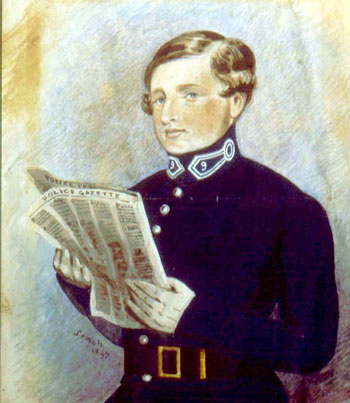
Portrait of unknown Cambridge Police Constable 9 dated 1847 by Richard Leach P.C. 8 W. Hackney, Acting Sgt in 1842 P.C. 9 George Richardson P.C. 10 David Carson; P.C. 11 John Clement[s] P.C. 12 Thomas Earl[e] P.C. 13 William Ballard; P.C. 14 Young suspended 26/3/1837; P.C. 16 Henry Benton P.C. 17 William Robinson P.C. 18 Henry Anable (Acting Sgt on 3/4/1838) P.C. 19 English Tyler [Tylor] to 1/5/1838;acting as Sgt on 5 January 1838 P.C. 20 James Atkinson;
P.C. 22 John Pond P.C. 23 Deborix; P.C. 24 Thomas Rocket[t] P.C. 25 Spink[s]; P.C. 26 Lee Hull (acted as Sgt 12/9/1837, 26/2/1838, 24/5/1838) top of page 1835-36 Thomas Hovell, a haberdasher
Cambridge Borough Watch Committee Feb 1836-37 The Mayor, Mr Alderman Humfrey, Mr Alderman Anderson, Mr Alderman Simpson, Mr Alderman Grafton, Mr Hallack, Mr Thomas Nutter, Mr Headley, Mr Coe, Mr Francis Eaden, Mr Warren, Mr Patrick Beale and Mr Searle (Borough Council Minutes 11 January 1836). Jan 1837-38 The Mayor, W.F. Coe, W. Anderson, F. Eaden, T. Hallack, W.Warren, T. Nutter, P. Beales, H.Headly, W.Searle, J.Skrine, G Livett, C.Newby, R.Foster Others
|
||
|
This page was last modified: 24 July 2025, 10:47
This site is powered by Web Wiz Green Hosting. We have been using their services for many years and are more than happy to recommend them to you. www.arumgo.com is a non-commercial web site currently containing material for police historians or those interested in local and family history. The site name was chosen for a place intended to be a shoe-box in which to store interesting things that make life in Silicon Fen of the 21st Century such arumgo 'Well, Sam,' said Mr. Pickwick, 'I intend to record all the interesting things we encounter in this journal'. 'That's rayther a rum go Sir,' replied Sam. |