Cambridgeshire
Police
History
Notes

CambridgeshirePoliceHistoryNotes |
|
|
|
Locations Balsham
|
Soham Police - The Soham Police Charge Book, 1848-1855| Home | Introduction | Rural policing in Cambridgeshire | Soham Police Force | Soham Cage | The New Police | Transcripts | Analysis | Cast list | The Murder of Richard Peak | Notes and Queries | Police Constable Richard Peak
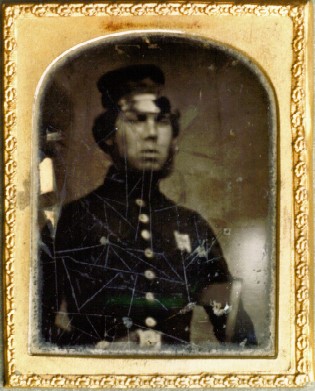
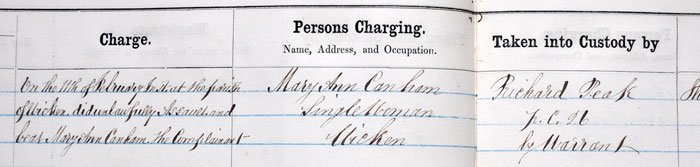
Ambrotype portrait of PC Richard Peak c.1855, probably taken by a travelling photographer Richard Peak was a Constable in the newly formed Cambridgeshire Constabulary from December 1852 to August 1855. The Cambridgeshire Constabulary was formed late in 1851 under a permissive Act of Parliament passed in 1839. Magistrates for the Isle of Ely part of the County had formed such a force in 1841. Between 1839 and 1851 the policing of the rest of the County had been undertaken mainly by the traditional arrangements of unpaid parish constables, local citizens appointed annually to serve by rota. Sometimes substitutes served by arrangement; the unlucky householder appointed for the year preferring to pay a pittance to another to serve rather than take up the duties himself. In several of the busier parishes however these arrangements were already proving inadequate and local residents called meetings of householders under other permissive legislation, the Lighting and Watching Acts from the 1830s, to levy a local rate, appoint Inspectors and, through them, appoint one or more paid policemen or watchmen. By 1851 this hotch-potch of local arrangements looked less attractive to local magistrates than the alternative of forming one of the new County-wide county police forces. These new forces built on the knowledge and expertise of other police organisations which were, by then, starting to be moderately successful at law enforcement and not so repressive of civil liberties as their earlier critics had feared. Besides, such arrangements would not prove to be much more costly in those places already levying a rate for watching. In any case, there were a number of difficult policing problems emerging. Crime generally appeared to be increasing, there had been problems with rural violence linked with protest, incendiarism in the face of the mechanisation of farming and violence linked with poaching; groups of navvies were moving about the country building the new railways and there was a growing feeling of insecurity in local communities. The new Cambridgeshire Constabulary’s first chief officer was appointed late in 1851. He was George Davies, a former naval captain with extensive experience of small boat actions and law enforcement with the Coast Guard. Davies quickly appointed and deployed his officers throughout the County early in 1852. Richard Peak was not amongst the first batch of recruits appointed, but vacancies occurred regularly in the Force as officers were found to be unsuitable or could not stand the difficult working conditions. Richard Peak was appointed as a Constable on 15th December 1852. He was posted at different times to the villages of Soham, Kirtling, Stetchworth, Wicken, Isleham and finally again to Wicken. The policy of the Chief Constable and the Justices was to keep moving officers between different posts so they did not become too familiar with the communities they served. The Soham charge book contains 15 cases handled by PC Peak during his short career. These were three assaults, three minor thefts, six licensing offences for after hours drinking, a criminal damage case, a case of embezzlement and a case of a man deserting his family. None of these relatively minor cases suggest that Richard's police work generated any enemies intent on causing him serious harm. Charges from all these cases can be seen in the transcript of the charge book.
Richard Peak was the son of a labourer, James Peak. He was born around 1831 at Eltisley Cambridgeshire. His mother was Martha Peak, who was a widow by 1851 and appeared to be a pauper. Martha was born in Caldecote, Cambridgeshire and was 45 years old in 1851. Richard had a brother William, born around 1846 in Caxton and a sister, Annie, born around 1840 at the same place. Richard was an agricultural labourer before joining the police. He seemed to have bettered himself by the career move as he married Ann Dennis Cooper, a dress maker, on 3rd March 1854 at the Independent Chapel in Soham; Anne’s family being slightly better off that Richard’s. Her father, Joseph Wood Cooper, was a grocer in Soham, later a rate collector and a man who owned his own house. Anne and Richard lived in a house in North Street Burwell when he was posted to Wicken in 1855. Anne and Richard had a son, Sidney William Peak, who was born on 24th July 1854. A second child, Alfred Cooper Peak, was to be born on 26th December 1855, by which point his father had disappeared. On the evening of 17th August 1855 Richard was supervising a grass sale taking place in the Red Lion public house in Wicken. No newspaper advertisements have been found for the sale, so it was probably only publicised with local notices. Nevertheless this would have been a busy local event and a chance for local farmers and farm workers to socialise and watch the bidding for grass for grazing and for hay. The pub landlord asked PC Peak to continue to look into the pub later than he had originally intended, apparently fearing there might be some sort of altercation as the evening progressed. After the public house closed in the early hours of the morning, Richard set off to walk back home across the fens to Burwell, too late by this time to make a pre-arranged conference point with an officer from a neighboring beat before retiring to bed. He failed to make the conference point and was never seen again. The most likely explanation for his disappearance is that he was murdered, but his body has never been found. Over the following weeks the Cambridgeshire Constabulary, under the direction of George Davies, undertook extensive searches and enquiries, all to no avail. Despite much speculation, the fate of the officer remains a mystery to this day. The few newspaper reports on the case are set out below. Wicken had its share of locals who had brushed with the law. In February 1853 labourers James Bacon and John Bailey were charged with assault with intent to rob a fellow labourer on the highway. The case appears to have been compromised before reaching court and the prisoners were discharged. Then in September 1853 local shepherd William Petch assaulted Wicken PC, James Carlow. When PC Carlow was in the process of arresting William Petch, he was confronted by labourers Thomas Fletcher, James Fletcher and George Bailey who actively incited Petch to assault and resist the officer. But - on PC Peak's final journey there may have been a greater danger lurking closer to his home in Burwell. Set out below is a letter to the press from a Burwell correspondent, written just 41 days after Richard's disappearance, complaining of the nightly thefts in the village by a well known gang of thieves. Even though the Force's scheme of guards and conference points changed periodically, local villains may well have observed officers meeting regularly at certain places and times, and could use this information to avoid chance encounters. On this occasion however, having missed his conference point with his neighboring officer, Richard Peak may have appeared in Burwell at an unexpected time and place, when he could have come across a crime in progress or stolen goods being moved. If he was murdered, how could his body have remained concealed after more than a century and three quarters? First, the extensive search of the surrounding area was probably not as thorough as suggested by the press. It was limited by the number of searchers available (as few as six officers some days) and the lack of experience and training in searching a area which including three parishes. Much of the search area would contain crops or disturbed ground or be under water. At this time drainage improvement work was taking place in the Burwell area as well as turf or peat digging and digging clay for brickmaking. Also, it is possible that the perpetrators could have moved the body to a more secure hiding place than had been available to them as dawn broke on the 18th August. The press explanation of Peak being in plain clothes suggests that he had specific instructions from his Sergeant or Superintendent to spend time in this public house and not in uniform. The relevant Orders and Regulations for the Government of the Cambridgeshire Constabulary under the Act 2 and 3 Vict cap 93, approved by the Justices in Quarter Sessions on 3rd day of April 1856, by George Davies Capt RN Chief Constable state:
Richard Peak's drink consumption that night, according to the landlord, amounted to today's equivalent of 4 units of alcohol. One possibility which George Davies must have considered was that the officer had absconded of his own volition. It was not unknown for a man to desert his family leaving them chargable to the Parish. The Soham charge book contains examples of around 40 cases of desertion over an eight year period where the offender was subsequently found and charged. All the features of the case, including Richard's character and financial and marital circumstances, must have convinced the Chief Constable not to pursue that line of enquiry. The claim in the press report below from 1st September 1855 that "all the outports and police stations in the kingdom have been communicated with" would appear to be inaccurate. The medium by which such communication would have been made was via the Police Gazette, but an annual volume from 1855 has been located (Durham County Record Office) and checked and it contains no mention of Richard Peak's disappearance. George Davies must have been convinced that the answer to Richard's disappearance was to be found locally? Surprisingly, no traces of Richard's case have been found in the Quarter Session records or rolls and there appears not to have been any compensating payment of any sort made by the Justices to Mrs Peak. Below are the few relevant items which appeared in the press. Cambridge Independent Press - Saturday 25 August 1855 p8 Peek [sic], one the Cambridgeshire rural police, stationed at Wicken, has been missed ever since yesterday week, and it is rumoured that be has met his death by foul means. On the evening in question he left his home, putting his staff in his pocket, to go on duty; he had little or no money in his pocket, and has not since been heard of. He has lately given evidence at Newmarket, against some loose characters, who have been heard to vow vengeance against him; and it is said that the party who had used the threatening language, are missing also. We trust, however, that the report of the policeman being murdered, will prove to be untrue; but, at any rate, in Wicken, Burwell, Soham, and throughout the neighborhood, the absence of the man, coupled with the circumstances, has created quite a sensation. Bury and Norwich Post - Wednesday 29 August 1855 p3 Suspected murder of a Policeman. On Friday, the 17th inst., an auction was held at the Red Lion, Wickham [sic], and caused a large number of persons to assemble, and some of them to remain until a very late hour. P.c. Richard Peek [sic], determined on seeing the house clear, remained until three o’clock on the following morning, when a fight took place, and he was obliged to use force to quiet it and protect himself, after which he left. At half-past three he was to have met the Burwell policeman somewhere between that place and Wicken, but did not do so, and has not since been seen or heard of. Various reports have been circulated respecting his disappearance, the finding of his body, and also that had run away after some female, but this idea his poor wife, whose state of mind may be better conceived than described (and on whom our correspondent has called), will not entertain for one moment. Her statement is, that the morning, before walking to Newmarket, he asked her for a few pence; that not having any smaller change she gave him a shilling, and that he had no more money with him; that he always gave her his salary, and that she had rather more than 3L. in the house; that his next month’s wages are nearly due, and her firm conviction is that he is murdered. One of the fellows who was fighting had a short time before threatened to "do his business" and he and another man (both bad characters) were found next morning asleep, or pretending to be so, in a stable in the inn yard and have been in such a restless disquieted state ever since as to excite great suspicion. The Cambridge papers state that one of them is missing, but the statement is incorrect. The police have dragged the ponds, searched the ditches, wells etc and accompanied by dogs have endeavoured to find the body, but up to this time without success. No trace of him whatever is to be found after his quitting the public house at day break. There is much corn standing in which the perpetrators of such a crime might for a time secrete their victim. The most intense excitement prevails in the neighborhood and it will not be at all allayed until the lands are cleared and an uninterrupted search can be made. Cambridge Chronicle, 1 September 1855 p5 THE LATE MYSTERIOUS DISAPPEARANCE OF THE WICKEN POLICE CONSTABLE. About a fortnight ago the sudden disappearance of a member of the Cambridgeshire rural police-force created quite a sensation in the neighborhoods of Burwell, Wicken, Soham and Fordham: and rumours soon spread that he must have met with foul play - rumours the more easily credited from the circumstances under which the disappearance took place, the character of the man himself, and the strenuous exertions of the other members of the force, headed by Captain Davies, the Chief Constable, and his deputy Mr. Lowe and backed (indeed in many cases personally aided) by the most influential inhabitants to discover signs of the fate of the missing Constable or the reason of his sudden withdrawal from his duty. It is to be regretted that to the present time all these exertions have been fruitless; unless indeed an inference may be drawn from the fact of the vigilant search instituted having failed in eliciting anything leading to the belief that the Constable has been otherwise than fairly treated, that he has suddenly taken himself off under mysterious and certainly discreditable circumstances. It is the duty of a journalist in such a case to present all the attainable evidence to his readers and leave them to form their own opinion and this we shall content ourselves with doing, merely remarking at the outset that our correspondent’s information has been gleaned from the most reliable resources and that he has kindly been allowed access to the reports relating to the matter now in the possession of the Chief Constable. It would appear that the missing Constable, Peak (26) was a member of the Wicken detachment and performed his duty according to the usual routine on the 17th August. On that day there was a sale by auction at the Lion public house Wicken which did not terminate until about 9pm. At the conclusion of the sale from forty to fifty persons were left assembled in the house and Peak continued going in and out at intervals until about 2am on the 18th. At this hour Peak expressed his intention of leaving for good but the landlord (Cranwell) pressed him to continue about the house as as he feared a disturbance among the parties congregated inside; and at the request of the latter he entered the house several times afterwards and finally ejected two parties who were noisy. The house was cleared at 3.15am and the company being dispersed Peak said to the landlord "Good morning; I've got an hour and a half's walk and then I will go to bed". This is the last that can be heard of him. Peak had a pint of beer and a shilling's worth or brandy and water in the house altogether; but the time in which he took it extended over some hours and he was perfectly sober when he left. Three men were fighting in the village at 4am on the 18th, but Peak was not there. When Peak left Wicken he was dressed in a brown straw hat, a brown great coat, a check coat, dark cloth vest, and pair of coarse uniform trousers, with black neck tie and Wellington Boots. The walk to which he alluded to to Cranwell was to the lower part of North Street, Burwell, where he ought according to disciplimentary regulations to have attended a conference of the neighboring patrol, meeting at this particular spot at 4am, but he did not appear. The apparent singularity of his dress is accounted for by the fact that members of the force have license to wear private clothes at night, on common occasions, in order to save their day uniforms; he had a staff and handcuffs in his pocket. His absence from the conference alluded to does not appear to have created any great surprise, as the men are allowed to absent themselves in case of any sudden contingency arising on their beat, they properly accounting for such absence in a report to headquarters. Saturday the 18th and Sunday the 19th passing over without and tidings of the missing man, much alarm was felt and on the Monday a rigorous search was instituted, which has been continued ever since, but without throwing any light on his fate. The search has been headed by Captain Davies and Mr. Low, assisted by six or eight members of the Force daily, to say nothing of the efficient aid afforded by the inhabitants headed by the incumbent and Mr. Johnson of Wicken; and Mr. Miller, surgeon of Soham all of whom have taken a deep interest in the affair. The fens and towns and villages for miles around have been searched without success, that is, up to Thursday evening last, not a drop of water that would float a cork within three miles being left uninspected or undragged. All the outports and police stations in the kingdom have been communicated with, but with the same result. A female in Brighton, it is said, to whom he previously paid some attention, has been written to and she has seen nor heard anything of him. Peak was about 25 years of age and entered the police force on 15 December 1852: he bore a good character as a steady and respectable man. He married a person from Soham and has left her at Burwell, where he resided with one child. He left all the clothes and money that he was known to be in possession of, and this is the fact that leads so many to the conviction that he has met foul play. He stood about 5 ft 10½ inches. His mother arrived at Wicken on Saturday last from Caxton. The excitement in the neighborhood is intense. Norwich Mercury, Saturday 13 October 1855 p6 Police-constable Peake [sic], of the Cambridgeshire constabulary, at Wicken, disappeared in a most mysterious manner several weeks ago, and no tidings have since been heard of him. There seems now to be no doubt the poor man has met with foul play, and that his body has been secretly buried. Cambridge Independent Press, Saturday 27 October 1855 p6 BURWELL DEPREDATIONS. (From a Correspondent.) If the true history could be written of the numbers, lives, and depredations of a gang of thieves too long suffered to run on in their unchecked career in this village and neighborhood, for many years, committing nightly depredations on all descriptions of property, without respect to ownership — if such a history could written, it would equal, if not surpass, that wondrous, well-known story of "The Forty thieves." Before the establishment of the County Police, this village was under the protection of paid parish constables; but, notwithstanding their vigilance, this den of thieves contrived to increase both in numbers and the amount of depredations — locks, bars, or bolts hindered them not — they were proof against these. Every crevice large enough to permit a thief's hand, head, or body to be thrust through, in every barn, granary, or house, was known and oft frequented by them; for every outhouse lock they had a pick-key in their possession — in fact, everything that base and cunning craft or wicked subtlety could devise they carried out. Such was this gang, and many an honest, industrious man, when, after the labours of the day, he had laid himself down to rest in sleep, has had these nocturnal visitors on his premises - if not in his house - robbing him of the fruits of his industry. The County Police have been established, policemen stationed in the parish, and the occupiers of the land have had yearly to pay towards the maintenance of the Police Force a considerable sum of money, and what is the state of affairs now? Why, the same gang of thieves, with a few exceptions, still exist - the same kind of depredations are of constant occurrence - property is almost as insecure as ever - those very men, born and bred to the profession, and who have for years been noted robbers, are noted robbers still; these men are known by all the parishioners - almost every man, woman, and child in the village can tell you their dwellings and occupation; and yet, night after night, they go in and out, here a little and there a great deal, they steal,and so subsist, idle, drunken, dissipated fellows, in the day; and whilst honest men are peacefully reposing in their slumbers, these villains are abroad, committing their midnight depredations, &c., laying their hands on whatever comes within their reach. Recently several robberies have been committed, some of them of an extensive kind; and such is the actual state of the place that the farmers dare not leave their corn either in the barn or the granary without private watchers being secreted on the premises: they themselves often keeping up night after night, not daring to leave corn until it is sold and delivered. Surely there is, or ought to be, some remedy: such a state of affairs ought not to be allowed longer to continue: the career of these thieves ought to be brought to a close: and, under the surveillance of our County Police, there ought to be security both for person and for property. We pay for it, and we ought to have it. One policeman is not, at this season of the year, and under present circumstances, sufficient protection, either to himself or the parishioners. No doubt he is watched in his going out and coming home - especially as he has given rounds to take, preconcerted arrangements made for him, and a regular plan laid before him as a guide to his movements: one night he may be expected to meet policeman A, at Wicken - next night, policeman B, on Newmarket Heath - a third night, policeman C, on the Swaffham Road, &c.; thus making up his weekly rounds, thus keeping him in exercise and communion with his brother officers and, whilst these policemen are holding their friendly meeting, and having a quiet chat on Newmarket Heath, or inhaling the softer air of the Fen districts, in the middle of the night, these robbers are busily employed making the best use of their absence, and taking quiet, undisturbed possession of other people's property. Why Mr. Editor, do I trouble you on such a matter? You are neither Captain, Superintendent, or policeman in the Force; but, Sir, the Press is, or ought to be, the public rectifier of public wrongs; and, if there are grievances existing, and wrongs committed, how are these deeds of darkness and malpractices to be stayed but by public exposure of the same, and by a public appeal to those whose duty it is to watch over the rights, properties, and interests of every honest man? Therefore, I make this public statement, through the medium of the Press, not wishing to censure, but to stir up to further diligence and duty those to whom we look as the protectors of our property and the upholders of our rights and privileges. We want, villagers, to enjoy peace, quiet, and security; we wish every man to obtain an honest livelihood, and, after, either by the sweat of his brow or the exercise of his brains, he has earned his daily bread, to repose in peace, without the fear of nocturnal depredators disturbing his rest, or robbing him of his hard-earned little treasure; we want to drive these thieves from their haunts, and to clear this village of this scum of society, alike corrupted and corrupting. The ravages of these depredators are not confined to this village alone: they spread far and wide into the adjacent counties. Where there are thieves there must be receivers too, and means and mode of transit for the stolen goods. The thieves are known, the receivers are known, and the means of transit known, by many, if not by most, of the parishioners. In this locality there are no rocky caves or densely wooded covers, affording hiding places for the robbers or their booty. With a level country, and no other means of transit but river and road, surely, by a little extra watching, patience, perseverance, and exertion, these evil proceedings could be put a stop to, and, by the vigilance of the police and the strong arm of the law, a speedy end might be put to these nefarious proceedings, and this desperate and lawless gang be dispersed or detected, and receive that punishment which they have for long time escaped, and which they so justly deceive. Cambridge Chronicle and Journal, Saturday 13 December 1856 p5 It will be remembered that in August 1855, p.c. Peek [sic], then stationed at Wicken, left home early one morning, on duty, and from that time up to the present no clue whatever of his whereabouts could be obtained, although every field of corn, pond, dike, and well, where it was thought he might have been thrown was searched. During the last few days the following report has become prevalent for many miles round the neighborhood, and although it is believed by many, we dare not undertake to vouch for the accuracy of it. It is said that a man residing in the fen was taken dangerously ill, and being anxious to disburden his conscience, made the following confession: that he knew what became of policeman Peek, who so mysteriously disappeared. He stated that he was murdered, by being knocked on the head, but he did not do the deed, but knew who did; and after he was knocked down he was thrown into the burning furnace of a brick kiln, in Burwell Fen, and burnt to ashes in a few minutes. We are informed that while the search was being made, a woman remarked that he must have been burnt in the brick-kiln in question, as on passing it the same morning he was missed, she observed a very peculiar and disagreeable smell. (The foregoing paragraph from the Bury Post. We have good authority to contradict it. At present there is no clue as to what became of the man)". The claim in the press report above from 1st September 1855 that "all the outports and police stations in the kingdom have been communicated with" would appear to be inaccurate. The medium by which such communication would have been made was via the Police Gazette, but a surviving volume from 1855 has been found and checked and it contains no mention of Richard Peak's disappearance. Does this indicate that the Chief Constable was satisfied that Richard had been killed locally and that there was no point in looking elsewhere for any different information explaining his whereabouts? Notes James Wentworth DAY, writer and historian, 1899-1983 mentioned this case in a number of his works. He depended on oral sources and much of what he has written is demonstrably inaccurate. Robert ASPLAND, the Chestnuts, Wicken, (enumerator of the 1861, 71 and 81 census returns for the village) may have kept a diary of Wicken events from around 1855 onwards. It is not known whether this document has survived. |
This page was last modified: 12 October 2025, 09:37
contact us
This site is powered by Web Wiz Green Hosting. We have been using their services for many years and are more than happy to recommend them to you.
www.arumgo.com is a non-commercial web site currently containing material for police historians or those interested in local and family history.
The site name was chosen for a place intended to be a shoe-box in which to store interesting things that make life in Silicon Fen of the 21st Century such arumgo
'Well, Sam,' said Mr. Pickwick, 'I intend to record all the interesting things we encounter in this journal'. 'That's rayther a rum go Sir,' replied Sam.